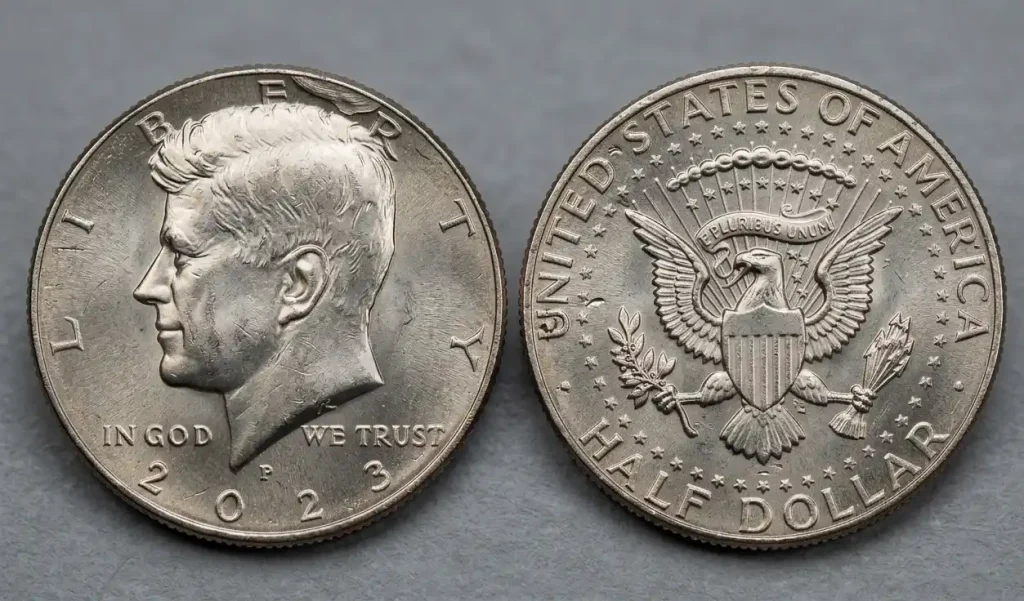
Evaluation of 2023 Half Dollars requires applying strict numismatic criteria.
And some 2023 Half Dollar errors result from the coin blank entering the printing unit partially.
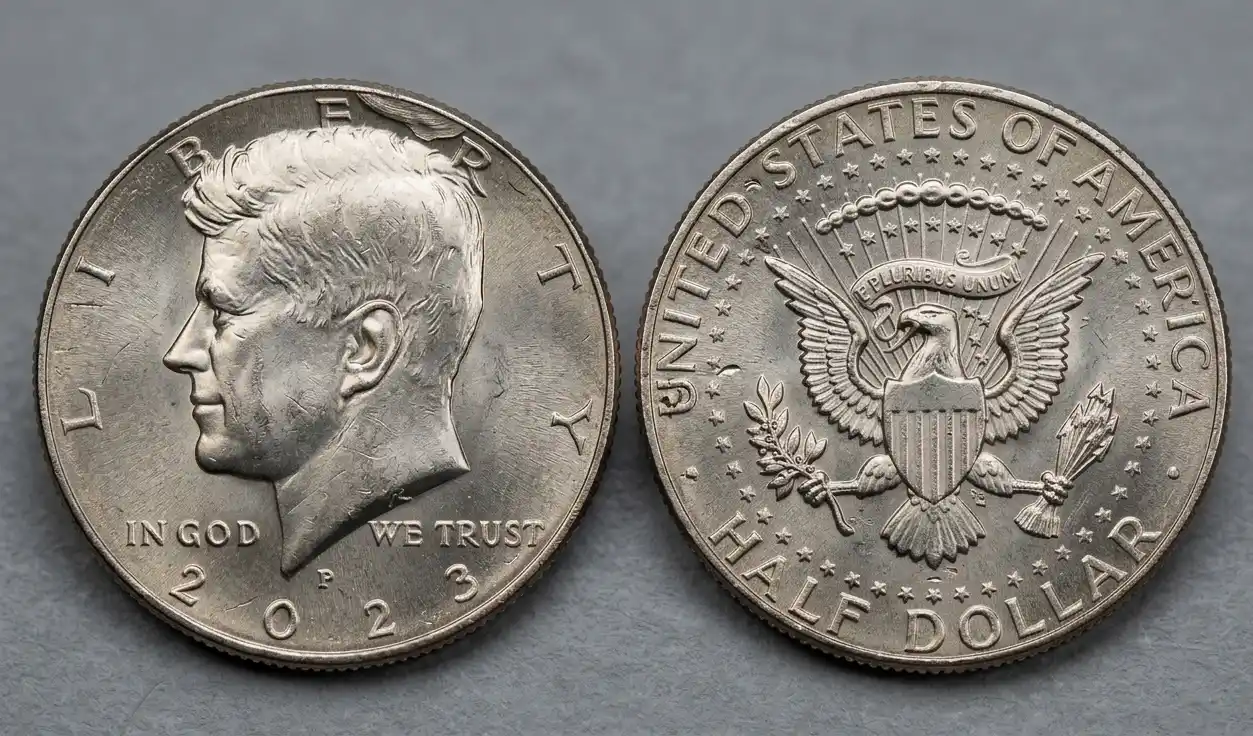
| Parameter | Value |
| Weight | 11.34 grams |
| Diameter | 30.61 millimeters |
| Thickness | 2.15 millimeters |
| Edge | Reeded |
| Metal | Copper-nickel alloy |
Error Classification: Doubled Die
Defects arise from shifting the stamp while applying the image to the working surface.
2023 coins show doubling most frequently within the LIBERTY inscription.
Sharpness of the contours defines the final preservation category.
Cause of occurrence → Technical failure in equipment alignment.
Price indicators based on condition:
- MS63: $45
- MS65: $110
- MS67: $350
Price change statistics for this error type: 2024: +12% 2025: +8% 2026: +5%
Image Displacement: Off-Center Strike
Recognizing value requires preserving the date of issue.
Specimens showing displacement under 10% receive minimum rates.
Value grading in 2026:
- 15% displacement with date preserved: $85
- 35% displacement lacking part of the profile: $190
- 50% displacement with fully readable year: $420
- Over 70% displacement: $150
Loss of date detail → Price reduction by 85%
Blank Defect: Metal Layering
Disruption of the alloy structure leads to peeling of the top nickel layer.
Exposing the inner core creates visual contrast.
Observers often mistake this defect for mechanical damage.
Verification includes weighing on high-precision scales.
Weight under 11.10 grams → Confirmation of manufacturing defect.
Weight within normal range → Probability of external impact.
Market quotes: Average price for a specimen losing 20% of its surface area stays at $65. Growth in value during the 2023–2026 period reached 18% of total volume.
Stamp Cracks: Die Cracks
Extended use of the tool causes micro-cracks appearing on its surface.
Raised chaotic lines manifest this defect on the coin.
Cracks connecting the coin edge to main design elements hold special value.
Error localization on the 2023 obverse:
- Kennedy’s hair area
- Space between letters E and R in LIBERTY
- Base of the profile neck
| Crack Type | Condition | Sale Price |
| Branched obverse crack | MS64 | $55 |
| Full die break | MS66 | $215 |
| Multiple reverse cracks | MS63 | $40 |
Missing Fragments: Clipped Planchet
Errors occur during the cutting of coin blanks from the metal strip.
Cutting shapes appear straight or curved.
Presence of the Blakesley effect confirms the originality of the defect.
Smoothing of the rim opposite the cut → Key marker of authenticity.
Pricing in the current quarter of 2026:
- Single cut up to 10%: $35
- Double cut: $120
- Deep curved cut over 25%: $310
Demand dynamics demonstrate stability without sharp fluctuations.
Stamp Collision: Die Clash
Contact between the obverse and reverse without a blank transfers image fragments.
2023 Half Dollars show eagle feather traces behind the president’s profile.
Detection difficulty requires using a coin checker app.
Finding shield contours on the front side increases object liquidity.
Realized lots: April 2025: $145 January 2026: $160
Metal Flow: Die Cuds
Errors feature missing parts of the image at the coin edge.
Empty space fills with an uncontrolled volume of metal.
Size of the flow stays directly proportional to the price.
Error characteristics:
- Affected area under 5 mm: $25
- Flow covering one digit of the date: $95
- Massive flow over 15% of area: $280
Increasing the coin weight by more than 0.05 grams during this error is not allowed.
Edging Machine Errors
Incorrect installation of the blank results in partial absence of reeding.
Smooth edges on 2023 coins appear extremely rarely.
Cases of total reeding degradation receive individual evaluation.
Cost varies from $50 to $150 depending on the field luster.
Impact of Preservation Grading on Price
Professional certification remains a mandatory stage for expensive errors.
Using recognized laboratory services increases the final value.
Grade influence on the price of a specimen with 25% displacement:
- MS60: $75
- MS63: $110
- MS65: $240
- MS67: $550
Dropping the grade by one step → Loss of up to 40% in potential profit.
Home Verification Methodology for Errors
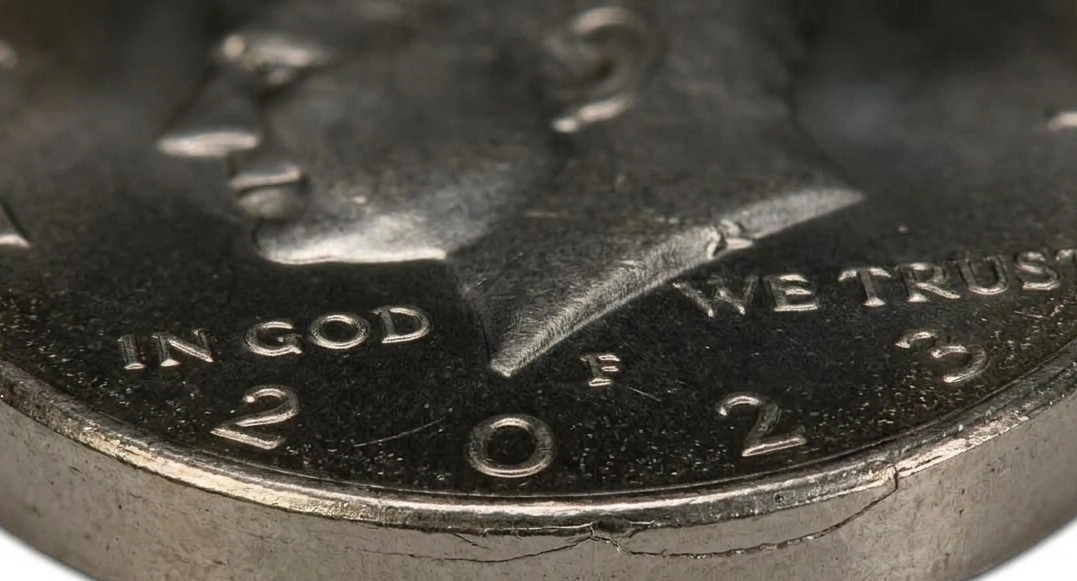
Initial inspection excludes coarse fakes.
Necessary toolkit:
- Digital microscope
- Scales with 0.01 gram steps
- Measuring calipers
- Reference 2023 coin
Sequence of actions:
- Comparing weight with the standard 11.34 gram value
- Analyzing the edge for signs of mechanical grinding
- Studying micro-relief in the defect zone
- Matching element placement with official matrices
Finding traces of glue or solder → Disqualification of the coin.
Investment Potential of the 2026 Segment
Rare 2023 errors show steady growth.
Limited supply forms a scarce market.
Percentage distribution of error types in private collections:
- Displacements: 30%
- Doubling: 25%
- Cracks: 20%
- Clips: 15%
- Other defects: 10%
Annual value growth for top grades reaches 12–15%.
Middle grades demonstrate inflationary correction at the 4–6% level.
Factors Reducing Liquidity
Presence of external impacts nullifies the error’s value.
Critical factors recognized:
- Cleaning with abrasive substances
- Contact with aggressive environments
- Deep field scratches
- Corrosion traces
Selling a damaged error occurs with a 70% discount.
Specifics of the 2023 Mintage
Total output volume in Denver and Philadelphia influenced error frequency.
The Denver mint features higher quality control.
| Mint | Share of Detected Defects | Average Error Price |
| Philadelphia (P) | 68% | $45 |
| Denver (D) | 32% | $75 |
Fewer mistakes in Denver cause increased interest in them.
Storage Recommendations for Valuable Specimens
Oxidation destroys the error’s micro-relief, you can use an app to scan coins for value if it happens.
Maintaining environmental conditions guarantees grade preservation.
Storage requirements:
- Temperature range: 18–22 degrees Celsius
- Air humidity: not exceeding 35%
- Use of acid-free holders
- Absence of direct sunlight
Contact with plastic containing harmful softeners causes irreversible surface degradation.